


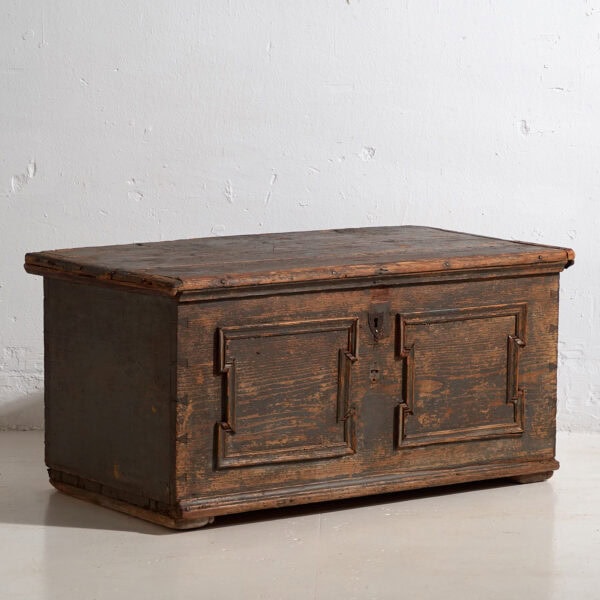


This antique panelled pine chest is a Central European storage trunk from the second half of the nineteenth century, built from solid pinewood and articulated on the front by two applied moulded panels.
Pieces of this kind accompanied domestic life in the regions of the Austro-Hungarian Empire, where the chest served as the principal piece of the household: inside, linens, household textiles, grain or documents were kept, while jars or small objects could be set on the lid. In contrast with the floral painted chest of the rural and nuptial tradition, this one belongs to the Central European burgher tradition rooted in Biedermeier: geometric panels, a monochrome palette and architectural sobriety. It is a piece built to last for several generations.
The construction is honest: pine boards joined with exposed dovetails at the four corners, a perimeter base with a simple moulding, and a flat lid set on long forged-iron strap hinges. On the front, two rectangular panels are framed by applied raised mouldings and separated by the central iron escutcheon, still bearing its original lozenge-shaped plate. Inside, a small lateral till running beneath the lid was used to keep jewellery, documents or small family treasures.
The original paintwork — a warm olive-grey, most likely applied in distemper — has weathered the decades with grace. Wear has worked the surface until the warm pine breathes through beneath the pigment, drawing a complex, living patina full of nuance. The forged-iron hardware retains its quiet oxidation, and the edges and corners show the natural rounding of domestic use. It is precisely in this ageing that the beauty of the piece resides.
In a contemporary interior, the chest works especially well in minimalist, wabi-sabi or Scandinavian-inspired spaces: its reduced palette and clean geometry converse with natural wood floors, lime-washed walls and modern furniture. As a low coffee table in front of the sofa, at the foot of a bed, or as an entry piece, it brings character, material and quietness.
- Type: Central European storage chest
- Style: Rural Biedermeier / Central European burgher art
- Materials and techniques: Solid pinewood, distemper monochrome paintwork, forged-iron hardware
- Place of origin: Central Europe — Austro-Hungarian Empire
- Period: Second half of the 19th century
- Date of manufacture: circa 1870
- Dimensions: Length 88 cm – Width 48 cm – Height 43 cm
- Condition: Original paintwork preserved with honest wear revealing the pine beneath; original forged-iron hardware and strap hinges; lateral interior till intact
At Amaru Antiques in Barcelona, we select each piece for its authenticity, its materiality and its ability to converse with contemporary interiors.
UNIQUE PIECE


