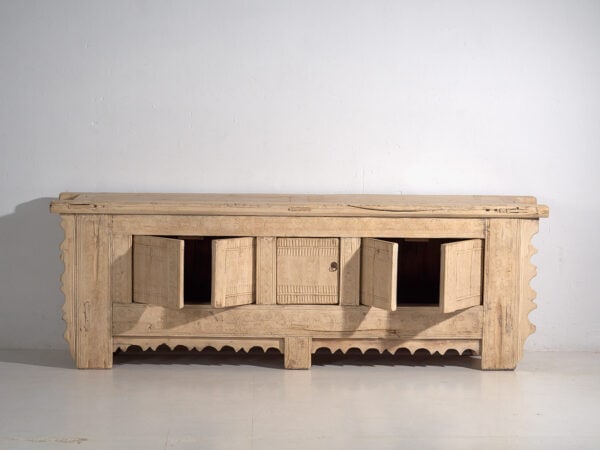


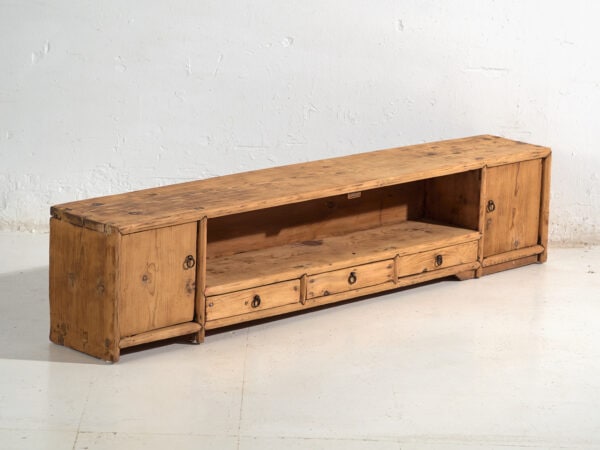


Antique low sideboard in pine wood, traditional Chinese furniture originating from Gansu and dated circa 1930. Originates from Gansu, in northwestern China, from the early 20th century, where local pine was worked using mortise-and-tenon joinery without nails, in a low and horizontal format.
In the rural houses of the Hexi corridor, narrow low sideboards served as a support surface beside the kang and as auxiliary furniture in the main room. Their reduced height suited the custom of living close to the floor.
Built in solid pine using traditional mortise-and-tenon joinery, without nails. The case articulates an open niche, two small lateral doors and three lower drawers, all with circular iron latch-style pulls. The sides are resolved as solid lateral plates, without exposed legs. The top is a continuous horizontal plane.
The patina retains the warm tone of aged pine, with visible grain and matte sheen. The surface shows dark marks left by objects resting over time, stains and traces of prolonged domestic use. The structure remains solid.
It fits naturally in minimalist, wabi-sabi or contemporary rustic interiors. It works as a low TV sideboard, a bench-sideboard in an entrance or a horizontal console facing a sofa. Its length lets it anchor a full wall.
Details
- Dimensions: Length 154.5 cm – Width 24 cm – Height 33 cm
- Style: Chinese northwestern provincial furniture
- Materials and techniques: Solid pine; mortise-and-tenon joinery without nails, two lateral doors, three lower drawers, open central niche, circular iron latch-style pulls
- Place of origin: Gansu, China
- Period: Early Republic of China (circa 1930)
- Date of manufacture: Circa 1930
- Condition / Notes: Sound structure. Original patina. Marks and traces of use. Wear consistent with age and use.
This piece is part of the collection of Amaru Antiques, Barcelona.
ONE OF A KIND PIECE