

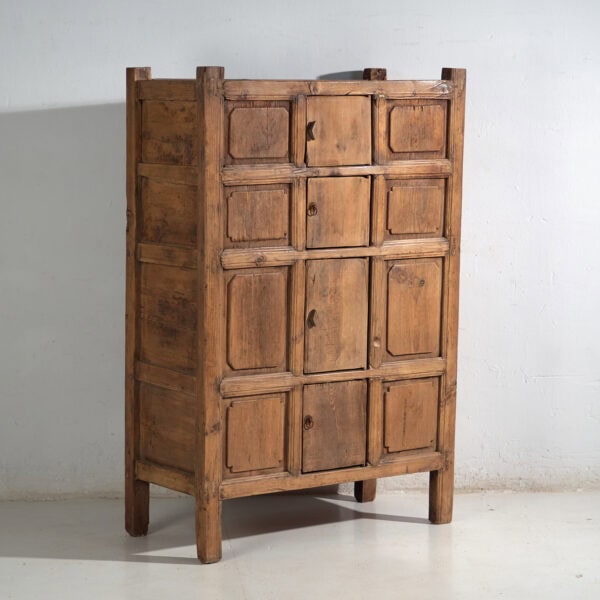


Antique tall cabinet in pine wood, traditional Chinese furniture from the Hexi corridor originating from Lanzhou and dated circa 1930. Originates from Lanzhou, in Gansu province (northwestern China), from the early 20th century, where local pine was worked using mortise-and-tenon joinery without nails, with fronts articulated in recessed geometric panels.
In the houses of the Hexi corridor, tall storage cabinets held household linen, textiles, bedding and objects of the family trousseau. Articulating the front in geometric panels responded both to a constructive logic — breaking down the large surface plane into manageable modules — and to an aesthetic preference for serial rhythm and the ornamental restraint of the northwest.
Built in solid pine using traditional mortise-and-tenon joinery, without nails. The front is organised into twelve framed panels arranged in four rows and three columns: the central column gathers the four operating doors, articulated by circular iron latch-style pulls, while the lateral columns present blind panels in the same language. Each panel is recessed with a moulded octagonal profile at the centre. The frame rests on four short exposed legs and is topped by a pediment of horizontal slats.
The patina retains the warm tone of aged pine, with the grain and knots visible on each panel. The sheen is matte. The surfaces show marks, stains and traces of prolonged domestic use, integrated into the wood. The structure remains solid and the original hardware is in place.
It fits naturally in minimalist, japandi or contemporary rustic interiors. It works as a storage cabinet in a bedroom, an anchor piece in a wide entrance or a vertical piece in a generously proportioned living room. The geometric articulation of the front gives it an architectural rhythm that dialogues with refined interiors.
Details
- Dimensions: Length 100 cm – Width 47 cm – Height 150 cm
- Style: Chinese provincial furniture from the Hexi corridor
- Materials and techniques: Solid pine; mortise-and-tenon joinery without nails, front articulated in twelve framed panels with recessed octagonal profile, four central operating doors, circular iron latch-style pulls, pediment of horizontal slats
- Place of origin: Lanzhou, Gansu, China
- Period: Qing Dinasty – Early Republic of China
- Date of manufacture: Circa 1900
- Condition / Notes: Sound structure. Original patina. Marks, knots and traces of use visible. Wear consistent with age and use.
This piece is part of the collection of Amaru Antiques, Barcelona.
ONE OF A KIND PIECE