


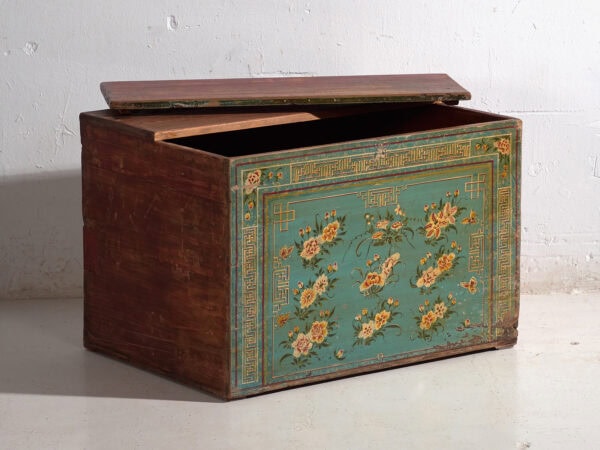


Antique Chinese trunk in pine wood, traditional storage furniture originating from Dongbei and dated circa 1930. Originates from Dongbei, in northeastern China, from the early 20th century, where pine was worked using traditional joinery without nails and reinforced with original wrought iron hardware.
In the rural houses of Dongbei in the early 20th century, storage trunks were central pieces of the domestic trousseau. They held clothing, textiles and personal belongings as part of the bridal dowry (jiazhuang), and that is why they often carried painted decoration on the front face — the only one visible when the trunk rested against the wall. They are part of the utilitarian tradition of northeastern China.
Built in solid pine. The hinged lid opens on original wrought iron hinges and retains the bolt lock. The edges carry a metal band as reinforcement. Side handles ease transport. Traditional carpentry without nails.
The front face retains its original polychrome decoration on a turquoise green ground, organised in three vertical floral sprays among which small butterflies alight, the whole composition framed by a double yellow border carrying the classic Chinese meander pattern (huiwen 回紋) and cruciform medallions in the four corners. The principal flowers are peonies (mudan 牡丹), the “queen of flowers” in China, emblem of prosperity and honour; among them appear curved-petal lilies — a traditional symbol of fertility and descendants — and small yellow chrysanthemums (ju 菊), one of the Four Gentlemen of Chinese art, associated with longevity and the contemplative life. The butterflies (die 蝶) reinforce that wish for long life and, paired with the flowers, add the classical reading of conjugal joy. The huiwen border around the composition stands for unbroken continuity.
The patina records the passage of time: the pine of the side faces and the lid shows a warm aged tone with the grain clearly legible, while the painted front displays the soft wear and craquelure of an original finish nearly a century old. The hardware has acquired a darkened surface through natural oxidation. The structure remains solid.
It fits naturally in contemporary rustic interiors, country houses or thematic galleries. It works as a storage piece at the foot of the bed, a low bench in an entrance or a decorative support in a corner. Its honest construction and painted front are its greatest value.
Details
- Dimensions: Length 74 cm – Width 54 cm – Height 50 cm
- Style: Chinese utilitarian furniture
- Materials and techniques: Solid pine, wrought iron hardware, bolt lock, lateral metal handles; hinged lid, traditional joinery without nails
- Place of origin: Dongbei, China
- Period: Late Qing dynasty / Early Republic of China (circa 1930)
- Date of manufacture: Circa 1930
- Condition / Notes: Sound structure. Functional hardware. Original patina and paint. Possible marks and traces of use. Wear consistent with age and use.
This piece is part of the collection of Amaru Antiques, Barcelona.
ONE OF A KIND PIECE


