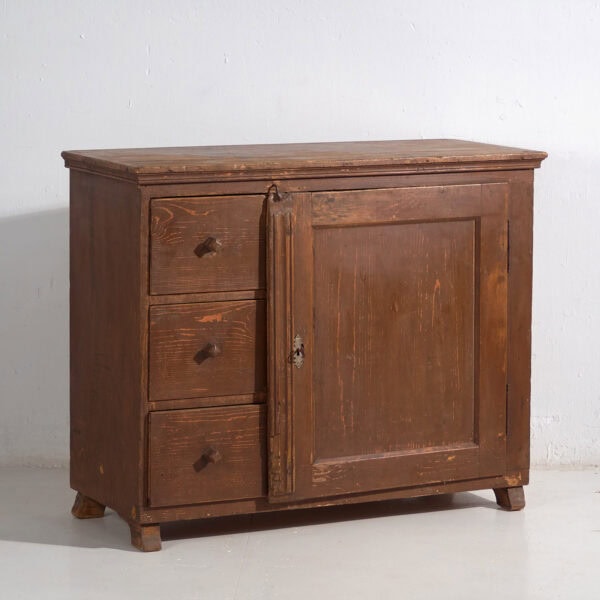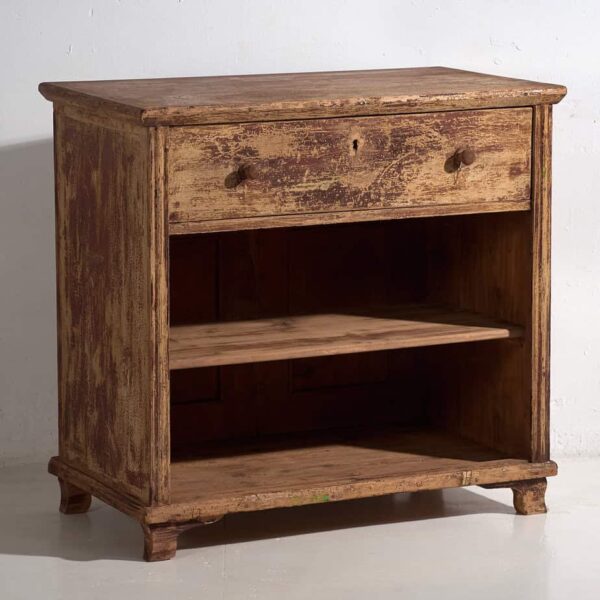


Antique small lacquered Japanese chest with two drawers, of elongated rectangular form and two stacked drawers at the front, with iron ring pulls and a dark lacquer finish. It originates from Japan, from the late Meiji period, where small chests of drawers furnished both the artisan’s bench and the inner rooms of urban houses.
This typology — a modest kodansu, without ornament — answered the logic of Japanese daily order: to keep tools, papers, threads or coins in identifiable drawers, leaving the upper surface clear. The natural lacquer protected the wood from dust and from the heat of the brazier, and gave it the characteristic deep, dark depth.
It is built in solid wood, with fronts and sides nailed and the drawers fitted on internal wooden runners. The pulls are hand-forged iron rings fixed to a square escutcheon, set centrally. The finish is natural black lacquer applied in several coats, today darkened to an almost deep brown.
The patina is warm and quiet, with perimeter wear at the edges, small splits along the grain and the lacquer softened by friction. Every scratch preserves the material trace of its domestic use — this is not a retroactively decorative object, but a functional piece that has reached us intact.
It sits naturally in wabi-sabi, japandi or contemporary minimal interiors. It works as a low side table beside a futon, as a tabletop box for jewellery and small objects, or as a base on which to set a ceramic or an open book, where the dark lacquer acts as the only graphic accent.
Details
- Dimensions: Length 22 cm – Width 45 cm – Height 24 cm
- Style: Traditional Japanese, Meiji period
- Materials and techniques: Solid wood; hand-forged iron pulls; natural black lacquer; nailed assembly with internal wooden runners.
- Place of origin: Japan
- Period: Meiji period (1868–1912)
- Date of manufacture: Circa 1910
- Condition: Good. Some scratches or marks consistent with use. Wear consistent with age and use.
This piece is part of the curated collection of Amaru Antiques, Barcelona.
ONE OF A KIND PIECE