

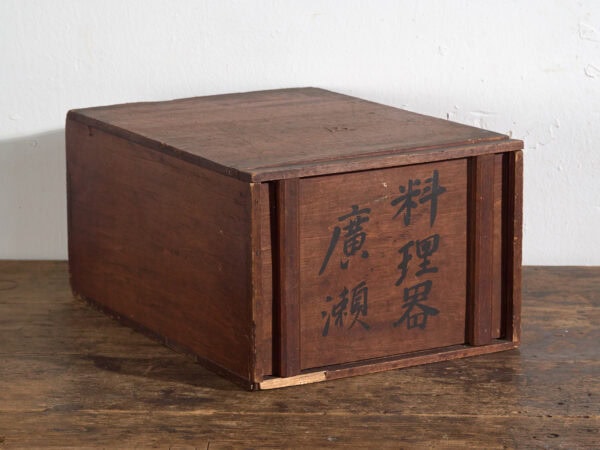


Antique Japanese storage box with calligraphy, of elongated rectangular form and sliding lid on lateral runners, decorated at the front with black-ink characters. It originates from Japan, from the Taisho or early Showa period, where storage boxes ordered kitchen utensils, shop supplies or personal effects in the family warehouse.
This typology — generically called kibako — was part of the portable furniture of the Japanese home and trade. Ink inscriptions named contents or owner: on this example the characters 料理器 (ryōri-ki, “cooking utensils”) identify the use, and 廣瀬 (Hirose), a family name, marks the owner or the workroom of origin.
It is built in solid wood, with boards nailed and the sliding lid running on two straight guides integrated into the upper edge. The interior walls are untreated, with the live look of sawn wood; the front and sides retain a warm tone produced by use and the natural oxidation of the fibre.
The calligraphy is broad and confident, brush-painted in dense black ink, and keeps all its contrast over the wood grain. The composition is austere, with no figurative motif, in the register typical of Japanese commercial boxes.
The patina is warm and honest, with the wood darkened in the most handled areas, small splits at the joints and the ink of the characters unaltered. Every mark preserves the material trace of its everyday function.
It sits naturally in wabi-sabi, japandi or contemporary rustic interiors. It works as a storage box for tableware, books or textiles, as a tabletop box for utensils, or as a standalone object on a sideboard, where the calligraphy reads as the only graphic note.
Details
- Dimensions: Length 23 cm – Width 45 cm – Height 33 cm
- Style: Traditional Japanese, Taisho / early Showa
- Materials and techniques: Solid wood; sliding lid on straight guides; brush-painted calligraphy in black ink; nailed assembly.
- Place of origin: Japan
- Period: Taisho / early Showa
- Date of manufacture: Circa 1920
- Condition: Good. Some marks consistent with use. Wear consistent with age and use.
This piece is part of the curated collection of Amaru Antiques, Barcelona.
ONE OF A KIND PIECE