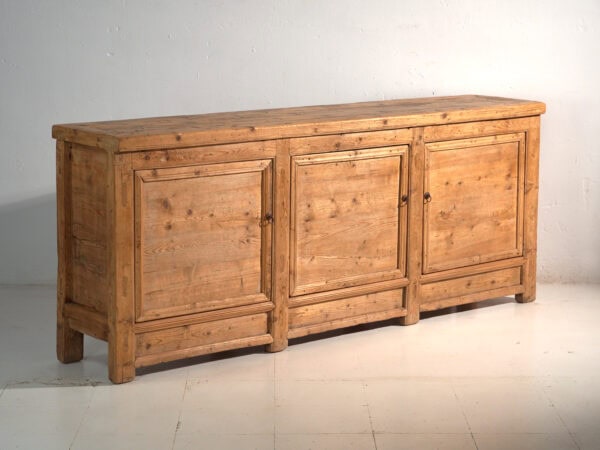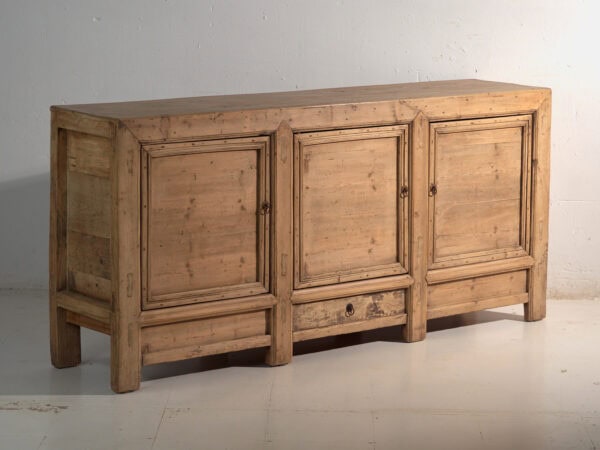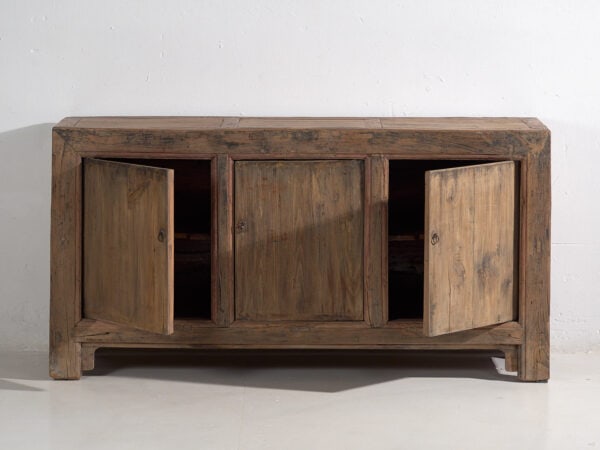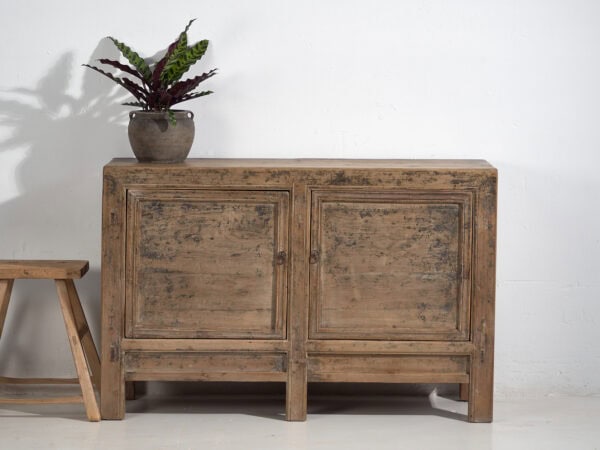


This antique painted sideboard in elm wood features three doors with pictorial panels of peonies, chrysanthemums and Chinese calligraphy. It originates from northern China, from the late Qing dynasty, where solid elm was worked using traditional mortise-and-tenon joinery.
In the domestic life of northern China, three-door sideboards stored ritual tableware, textiles and family belongings. Painting over lacquer was an act of care: each peony and each character was applied as a wish for household prosperity. The type spread through the provinces of northern China during the nineteenth century and remained in use through the early decades of the twentieth.
The body is built in solid elm, a hard and stable wood native to the region. The round pulls are hand-forged iron, secured with visible rivets. The construction is traditional Chinese mortise-and-tenon, without metal fasteners, with the side panels fitted into the vertical uprights. The lower apron is shaped with a soft profile and the legs continue straight to the floor.
The painted decoration is concentrated on the three front panels. Over a dark lacquer ground, compositions of peony (mudan 牡丹) and chrysanthemum (ju 菊) appear in vessels set on low tables. The peony is the queen of flowers and stands for wealth and honour; the chrysanthemum, one of the Four Gentlemen, evokes longevity and contemplative retreat. Each panel is topped with a band of Chinese calligraphy in red pigment. The palette combines earthy reds, ochres, golds and black strokes over the lacquered ground.
The patina reads the passage of time clearly. The original lacquer has worn away on the contact surfaces, revealing the raw elm at the upper edges and corners. On the central panels, the pigment remains firm but softened. This layered reading of the surface is characteristic of painted furniture from northern China and is part of the historical value of the piece.
With its contained proportions, this sideboard works well in wabi-sabi, japandi and contemporary rustic interiors. It can serve in an entrance as a welcoming piece, in a living room as a low storage cabinet, or in a dining room as a service sideboard. It also adapts as a low cabinet for television in Asian-inspired rooms.
Details
- Dimensions: Length 163 cm – Width 45 cm – Height 84 cm
- Style: Qing Dynasty
- Materials and techniques: Solid elm; hand-forged iron hardware; traditional Chinese mortise-and-tenon joinery; original polychromy and lacquer with aged patina.
- Place of origin: China
- Period: Late Qing dynasty / Early Republic
- Date of manufacture: Circa 1900
- Condition: Good. Original patina and paintwork preserved. Wear consistent with age and use.
This piece is part of the curated collection of Amaru Antiques, Barcelona.
ONE OF A KIND PIECE