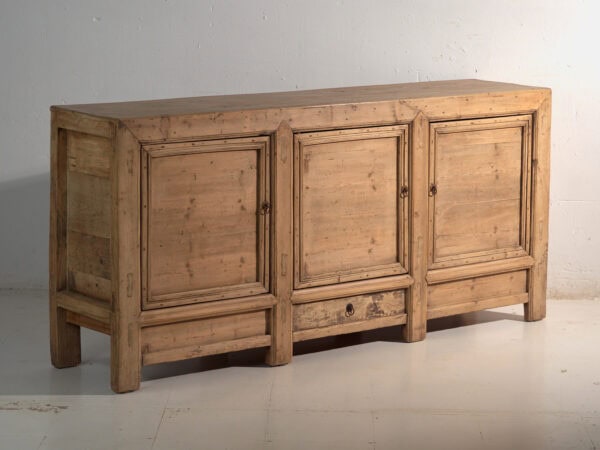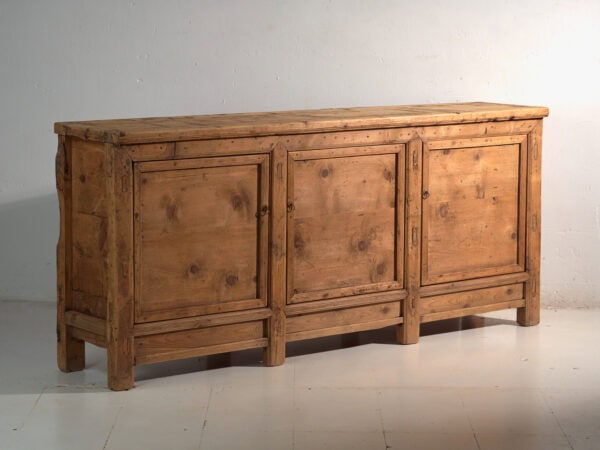


This antique sideboard in elm wood with three doors features framed panels with raised central field and traces of dark red pigment on the frames. It originates from northern China, from the late Qing dynasty, where solid elm was worked using traditional mortise-and-tenon joinery.
In the houses of the northern provinces, long three-door sideboards stood in the main room and served to order tableware, textiles and everyday items. The structure with a raised central field is a sober variant of the typology, with no painted panels, where expression rests entirely on the wood and on the rhythm of the framing.
The body is built in solid elm, with a top board composed of three planks joined at their ends. The fronts show three identical doors with perimeter frame and recessed central field. The hardware is hand-forged iron, with circular pull secured by rivet. The construction is traditional Chinese mortise-and-tenon, without metal fasteners. The lower apron is straight and the legs continue square to the floor.
The patina preserves traces of the original polychromy: a dark red pigment partly covers the frames and reveals the elm in the contact areas. The top shows the natural figure of the grain, with soft variations of warm tone. The hardware presents stable oxidation. This layering — wood, residual pigment, oxidation — is the honest reading of time on a domestic piece in continuous use.
With a length of just over two metres and a height of 96 cm, this sideboard has imposing scale. It suits ample living rooms, dining rooms and long hallways. It works in wabi-sabi, japandi, contemporary rustic interiors and Asian-inspired rooms. As low storage for television, it has the right height to hang a screen above.
Details
- Dimensions: Length 206 cm – Width 45 cm – Height 96 cm
- Style: Qing Dynasty
- Materials and techniques: Solid elm; hand-forged iron hardware; traditional Chinese mortise-and-tenon joinery; traces of original pigment on the frames.
- Place of origin: China
- Period: Late Qing dynasty / Early Republic
- Date of manufacture: Circa 1900
- Condition: Good. Traces of dark red pigment on frames and warm patina on the elm. Wear consistent with age and use.
This piece is part of the curated collection of Amaru Antiques, Barcelona.
ONE OF A KIND PIECE