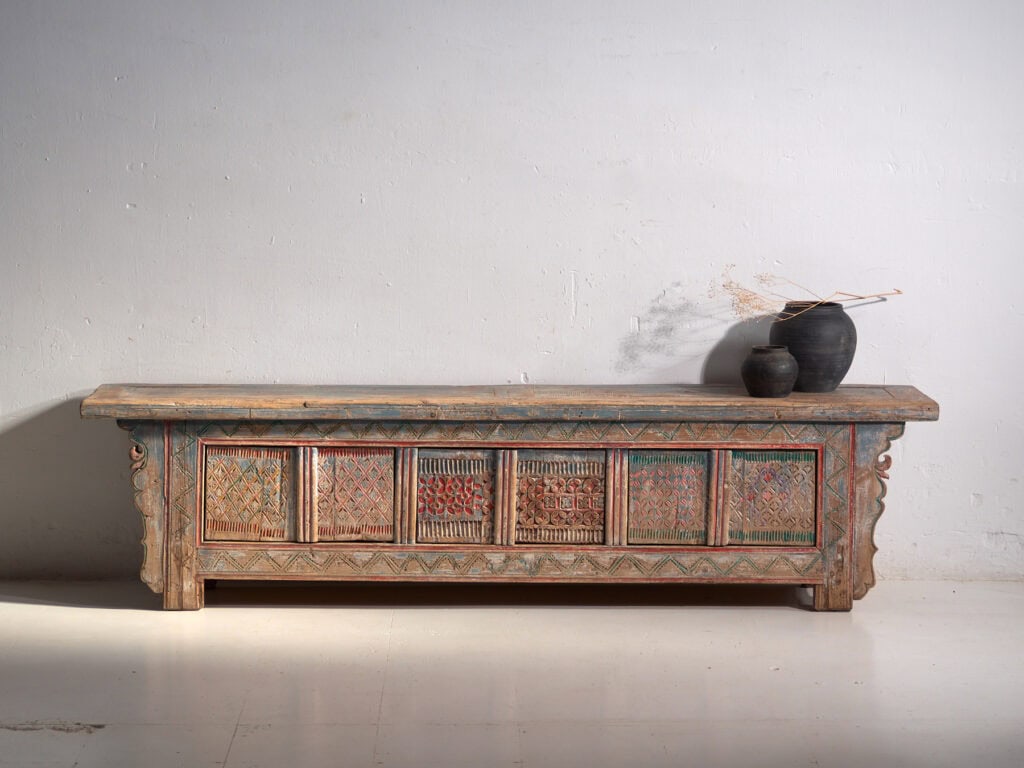


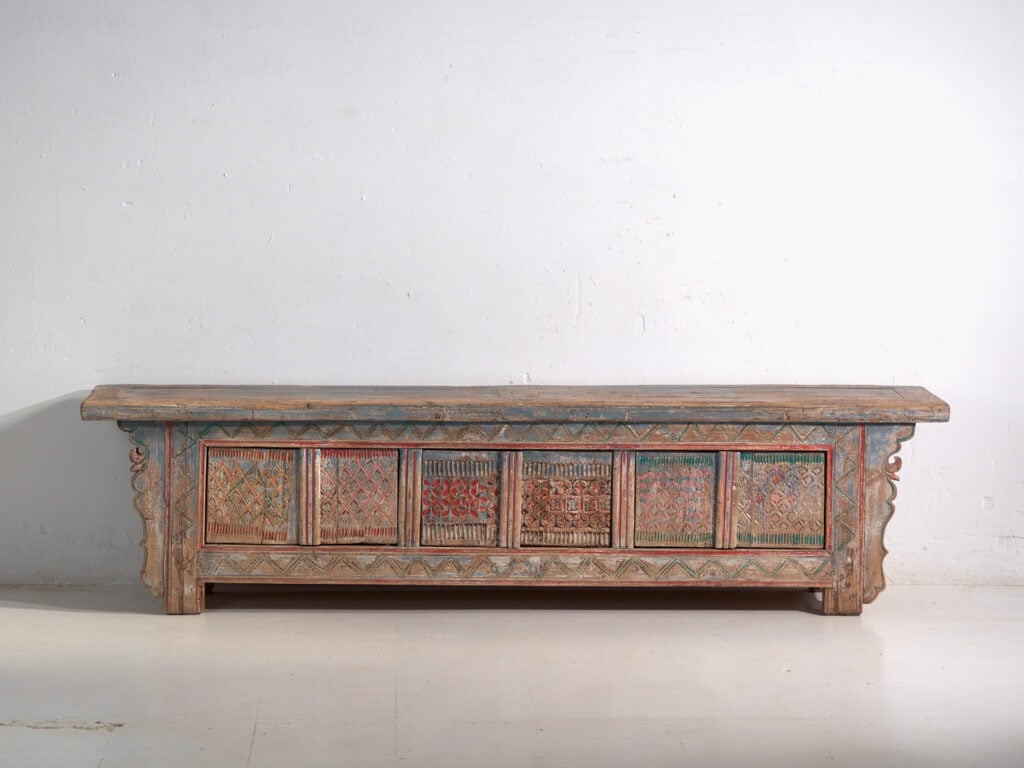


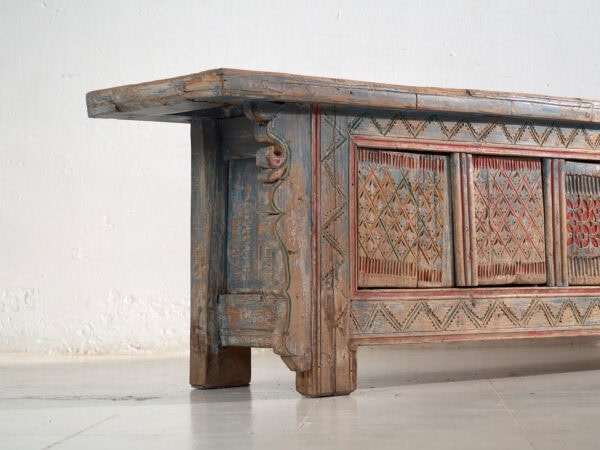


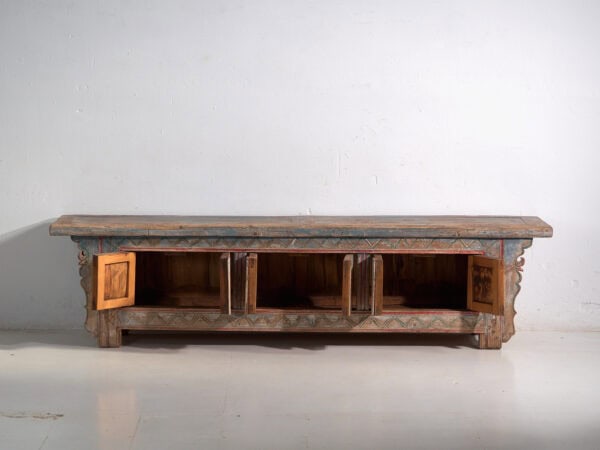

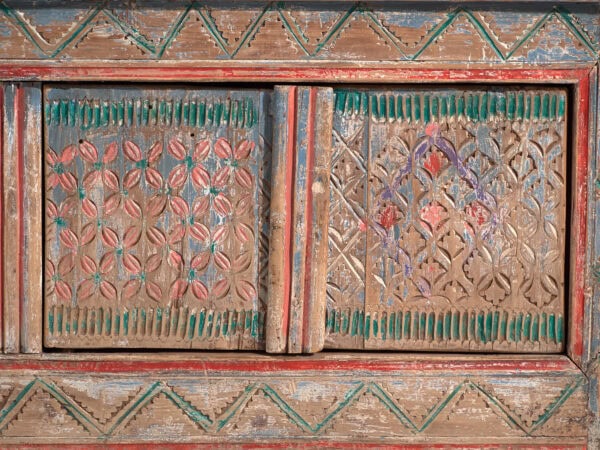
This antique carved and polychrome low sideboard in fir wood features a front with six carved panels of diamond motifs and carved borders at the top and bottom. The surface preserves original polychromy in blue, red, green and yellow. It originates from the high plateau of western China, from the late Qing dynasty, where fir was worked using traditional mortise-and-tenon joinery.
Furniture from this region belongs to the cultural area of the Tibetan plateau and shows the joint influence of western China and the Tibetan tradition. Polychromy over flat carving — common in low sideboards, low benches and tables — used mineral pigments that the dry climate of the region has preserved for decades. Low sideboard of this type served in the house to store textiles, festival clothes and ritual goods.
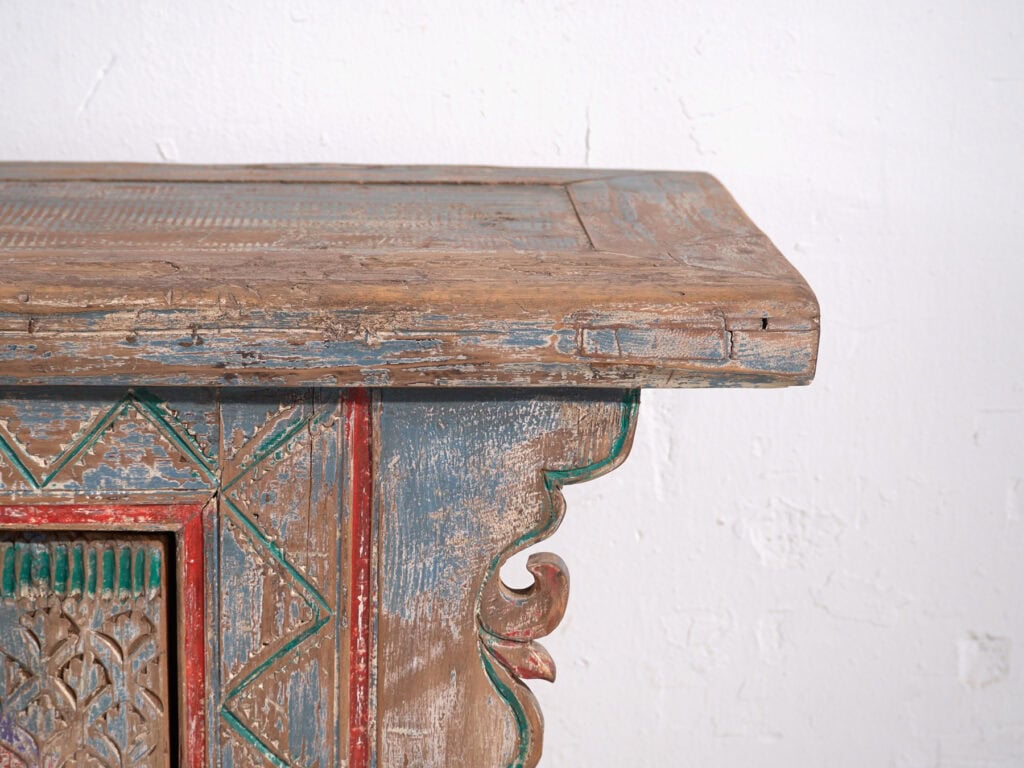
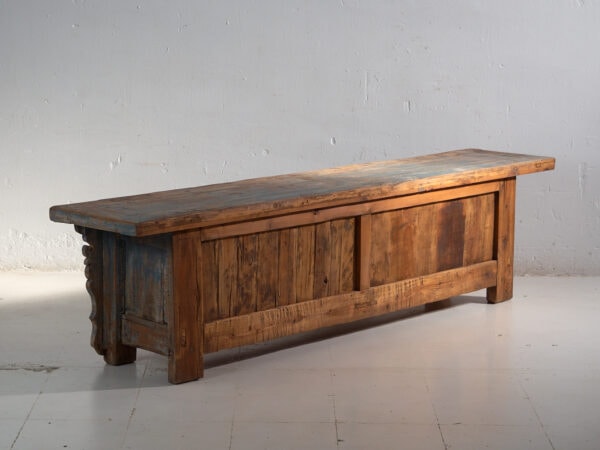
The body is built in solid fir. The front face is divided into six recessed square panels with carved diamond motifs. Above and below run carved borders with zigzag and continuous line. The sides carry carved brackets with a scalloped outline and small hand-forged iron pulls. The construction is traditional Chinese mortise-and-tenon, without metal fasteners. The 60 cm height places the piece between a low sideboard and a storage bench.
Residual polychromy is concentrated on the relief: cobalt blue, vermilion red, malachite green and ochre yellow fill the hollows of the carving and follow the rhythm of the design. Over the panel ground and the borders, the lighter paint has been preserved. The whole presents a stable aging that maintains the original chromatic reading.
The patina shows the passage of time without altering the richness of the decoration. The most exposed areas — top edges, corners — have lost pigment and reveal the fir underneath. The top surface bears use marks and small longitudinal cracks. The whole has been kept in continuous use.
Given its low height and generous length, this low sideboard plays a clear decorative and functional role. It serves as a bench at the foot of a bed, as a low console under a window, or as an anchor piece in large entrances. It fits wabi-sabi, contemporary rustic and Tibetan, Mongolian or Central-Asian inspired projects.
Details
- Dimensions: Length 242 cm – Width 45 cm – Height 60 cm
- Style: Qing Dynasty
- Materials and techniques: Solid fir; traditional Chinese mortise-and-tenon joinery; flat carving with six geometric panels and continuous borders; residual polychromy in blue, red, green and yellow.
- Place of origin: China
- Period: Late Qing dynasty / Early Republic
- Date of manufacture: Circa 1930
- Condition: Good. Carving and residual polychromy original and preserved, natural patina. Wear consistent with age and use.
This piece is part of the curated collection of Amaru Antiques, Barcelona.
ONE OF A KIND PIECE