

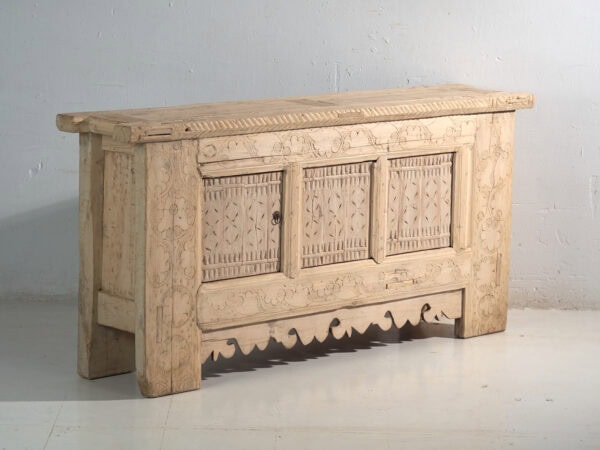


This antique carved sideboard in fir wood features a front with three vertical carved panels in flat relief, an upper foliate border and a scalloped lower apron. It originates from northwestern China, from the late Qing dynasty, where fir was worked using traditional mortise-and-tenon joinery.
Domestic furniture from northwestern China combines mainland constructive tradition with a geometric decorative vocabulary of local roots. The repeated flat carving — parallel vertical motifs, interlaced foliate borders, scalloped aprons — covers the front surface with regular rhythm and stands as a recognisable regional mark.
The body is built in solid fir. The front face is divided into three recessed square panels carved with vertical motifs in flat relief. Above the panels runs a carved foliate border with interlaced leaf motifs. The lower apron has a scalloped profile. The sides are solid. The construction is traditional Chinese mortise-and-tenon, without metal fasteners.
The patina presents a pale bleached tone, the result of natural aging of fir and the loss of the original finish. The carving keeps its definition and the hollows of the relief gather shadows that highlight the design. The top surface shows the natural grain with small longitudinal cracks consistent with age.
With its 181 cm length and 87 cm height, this sideboard works as a piece of imposing presence in living rooms, dining rooms and entrances. It suits wabi-sabi, japandi, contemporary rustic and Asian-inspired interiors.
Details
- Dimensions: Length 181 cm – Width 41 cm – Height 87 cm
- Style: Qing Dynasty
- Materials and techniques: Solid fir; hand-forged iron hardware; traditional Chinese mortise-and-tenon joinery; flat carving with vertical geometric motifs and foliate borders.
- Place of origin: China
- Period: Late Qing dynasty / Early Republic
- Date of manufacture: Circa 1930
- Condition: Good. Pale bleached patina with dense carving preserved and scalloped lower apron. Wear consistent with age and use.
This piece is part of the curated collection of Amaru Antiques, Barcelona.
ONE OF A KIND PIECE