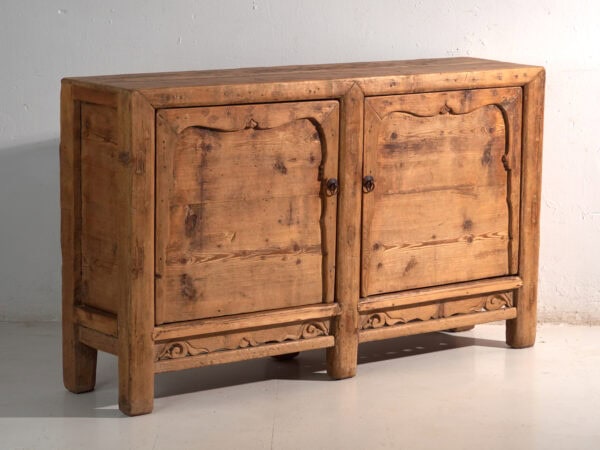


This antique sideboard in elm wood features two doors with a perimeter frame and a recessed central field on each, over a simple lower apron. It originates from China, from the mid-twentieth century, where elm was worked using traditional mortise-and-tenon joinery while preserving the classical Qing typologies.
Chinese furniture from the mid-twentieth century preserved traditional constructive logic with a more sober formal language than late Qing pieces. Two-door sideboards with solid sides remained the standard typology, now with cleaner surfaces and less decorative carving, adjusted to twentieth-century taste.
The body is built in solid elm. The front comprises two identical doors with a profiled perimeter frame and a recessed central field. The sides are solid. The lower apron has a simple profile and the legs continue square to the floor. The pulls are circular hand-forged iron rings. The construction is traditional Chinese mortise-and-tenon, without metal fasteners.
The patina keeps a warm brown tone with the elm grain visible. The top surface shows the natural figure of the wood with soft chromatic variations and the hardware presents stable oxidation. The most exposed areas have acquired a darker tone through handling.
With its 178 cm length and 87 cm height, this sideboard works as a piece of imposing presence in living rooms, dining rooms, entrances and bedrooms. It suits wabi-sabi, japandi, mid-century, contemporary rustic and Asian-inspired interiors.
Details
- Dimensions: Length 178 cm – Width 45 cm – Height 87 cm
- Style: Qing Dynasty
- Materials and techniques: Solid elm; hand-forged iron hardware; traditional Chinese mortise-and-tenon joinery.
- Place of origin: China
- Period: Mid-twentieth century
- Date of manufacture: Circa 1950
- Condition: Good. Warm brown patina with elm grain visible. Wear consistent with age and use.
This piece is part of the curated collection of Amaru Antiques, Barcelona.
ONE OF A KIND PIECE