

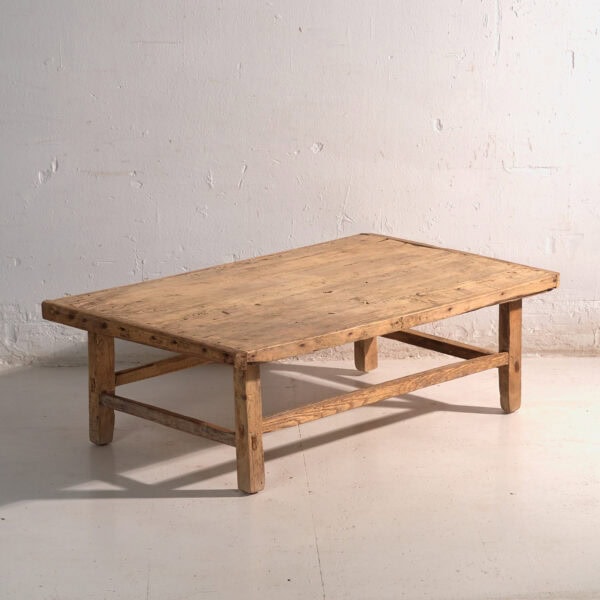


This antique low table in pine wood is a Chinese coffee table with a thick plank top raised on four legs joined by stretchers, built with mortise-and-tenon joinery. It originates from northern China, from the late Qing dynasty, where solid pine was worked with traditional joints and no metal hardware.
Broad low tables of this kind held the centre of the room in the Chinese home, serving as a surface for tea and meals and as a gathering point at low height. Their sturdiness and formal simplicity answered to intense, everyday use.
The top is solid pine of good thickness, set on straight-section legs braced by stretchers. The joints are mortise-and-tenon, fitted by hand, and the wood keeps the tool marks on its edges and ends. The whole is stable and notably heavy.
The patina is warm and uneven, born of use: the pine shows its grain and knots beneath a soft wear, with tones from honey to chestnut and small marks and dents that tell its story. The surface reads as living, not over-restored, wood.
Its broad proportion and low height suit use as a living-room coffee table in front of a sofa, or as a large-surface tea table. It fits wabi-sabi, japandi, contemporary rustic and Asian-feeling interiors, where it brings presence and an honest working surface.
Details
- Dimensions: Length 105 cm – Width 65 cm – Height 34 cm
- Style: Qing dynasty
- Materials and techniques: Solid pine; traditional Chinese mortise-and-tenon joinery.
- Place of origin: China
- Period: Late Qing dynasty
- Date of manufacture: Circa 1890
- Condition: Good. Honest patina and wear on the pine, with marks and stains consistent with use. Wear consistent with age and use.
This piece is part of the curated collection of Amaru Antiques, Barcelona.
ONE OF A KIND PIECE