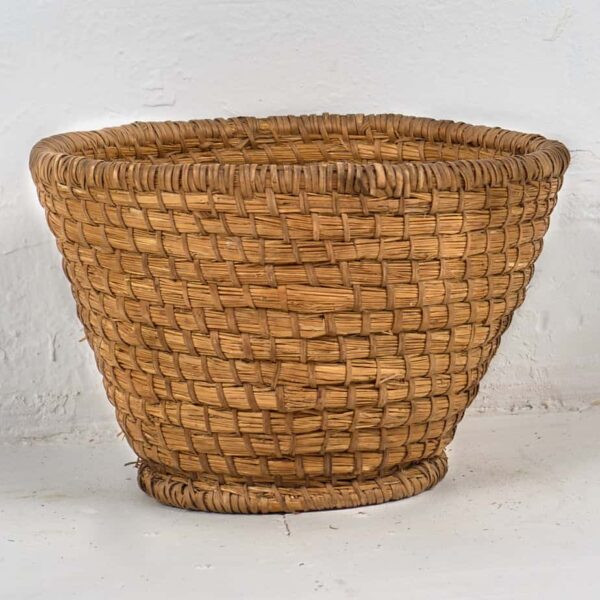


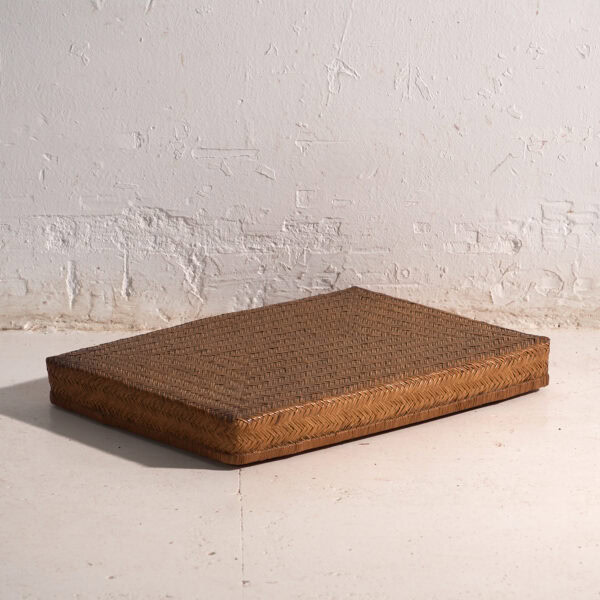


This set of two antique Japanese flat cases is composed by two woven-rattan containers with a low profile, a full lid and a herringbone (ajiro) weave over a wooden frame. It originates from Japan, from the Taishō period, around 1920, where rattan and cane were hand-plaited for domestic storage.
In the Japanese home, flat woven-fibre cases held textiles, papers and personal objects — light and breathable where wooden trunks were heavy. The herringbone weave, ajiro (網代), is a traditional Japanese technique combining strength with a regular geometric pattern.
Body and lid are plaited in rattan over a wooden frame, with a tight herringbone weave that gives the whole its rigidity. The edges are finished with a thicker plait and the corners are reinforced at the points of greatest wear. The work is entirely by hand.
The fibre has taken a warm honey-coloured patina, more golden on the lid and darker on the edges with use. Some areas of the weave show wear and small losses consistent with age, revealing the honesty of the material and of the handwork.
As a decorative object, it works as open storage, a deep tray on a chest of drawers or a low-table piece. It fits wabi-sabi, japandi, contemporary rustic and Japanese-feeling interiors, where it brings natural texture and a handcrafted note.
Details
- Dimensions: Length 59 cm – Width 42 cm – Height 8 cm
- Style: Taishō period
- Materials and techniques: Rattan plaited in herringbone (ajiro); wooden frame.
- Place of origin: Japan
- Period: Taishō period
- Date of manufacture: Circa 1920
- Condition: Good. Sound herringbone weave with warm patina; wear and some loss consistent with age. Wear consistent with age and use.
This piece is part of the curated collection of Amaru Antiques, Barcelona.
ONE OF A KIND PIECE