

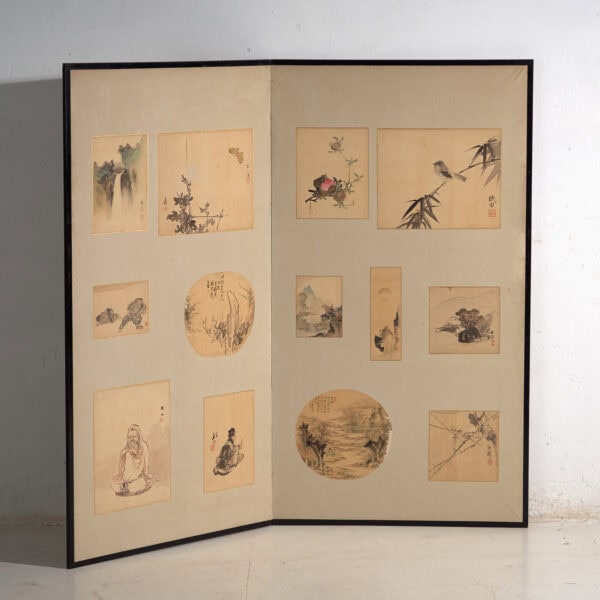


This antique Japanese two-panel screen is a byōbu in harimaze mounting, with pasted ink paintings on the ground. It originates from Japan, from the Meiji period, when small works were gathered on a single screen.
The harimaze screen gathered paintings of different formats mounted together on a common ground. It was a way to keep and show a series of ink works.
The two panels are paper over a wooden lattice, joined by paper hinges, with a black frame. On the ground the paintings were pasted in rectangular, round and fan formats.
The composition gathers birds, bamboo, flowers and landscapes in ink, in varied formats. Each painting keeps its signature or seal, and the whole reads as a repertoire of classical Japanese motifs.
For its two-panel format, it serves as a decorative backdrop or a wall piece with collection value. It fits wabi-sabi, japandi and minimalist interiors, where it brings serenity and a graphic accent.
Details
- Dimensions: Length 154 cm – Width 1 cm – Height 139 cm
- Style: Traditional Japanese
- Materials and techniques: Paper and pasted ink paintings (harimaze) over wooden lattice; paper hinges; black frame.
- Place of origin: Japan
- Period: Meiji period
- Date of manufacture: Circa 1900
- Condition: Good. Mounted paintings with patina and marks consistent with age. Folded dimensions: Length 77 cm – Width 2 cm – Height 139 cm. Wear consistent with age and use.
This piece is part of the curated collection of Amaru Antiques, Barcelona.
ONE OF A KIND PIECE