

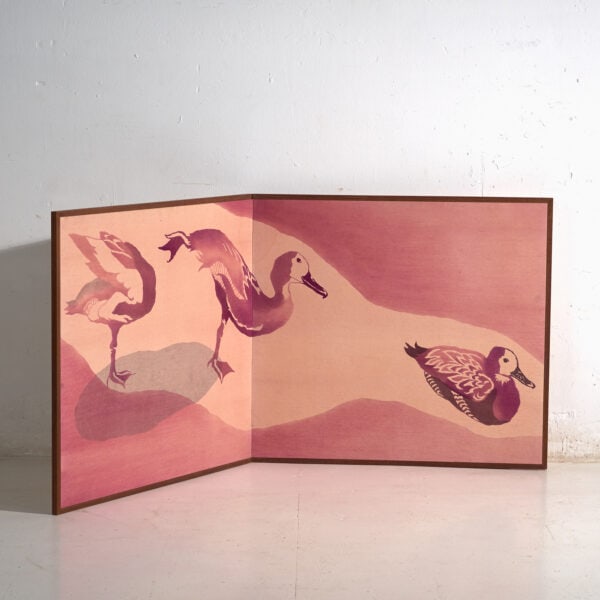


This Japanese two-panel screen is a byōbu in resist-dyed textile (katazome) with a mandarin duck motif. It originates from Japan, from the twentieth century, within Japanese textile art mounted as a screen.
Stencil resist dyeing (katazome) is a traditional Japanese technique for printing cloth with rice paste and natural dyes. Mounted as a screen, the textile becomes a work to display and to divide space.
The two panels are dyed cloth mounted over a wooden lattice, joined by hinges and framed in wood. The motif develops across the two panels in a range of pink tones.
The composition depicts mandarin ducks (oshidori) on a pink-toned ground, dyed by katazome. The pair of mandarin ducks symbolises conjugal love and fidelity in the Japanese tradition. It keeps a label with the title 「彩霞」 and the maker’s name.
For its low, two-panel format, it serves as a decorative backdrop, an occasional divider or a wall piece. It fits wabi-sabi, japandi and contemporary interiors, where it brings soft colour and textile texture.
Details
- Dimensions: Length 179 cm – Width 2 cm – Height 82 cm
- Style: Japanese textile art
- Materials and techniques: Resist-dyed textile (katazome) over wooden lattice; hinges; wooden frame.
- Place of origin: Japan
- Period: 20th century
- Date of manufacture: Circa 1985
- Condition: Good. Textile with light patina and marks consistent with use; keeps a title label. Folded dimensions: Length 89 cm – Width 4 cm – Height 82 cm. Wear consistent with age and use.
This piece is part of the curated collection of Amaru Antiques, Barcelona.
ONE OF A KIND PIECE