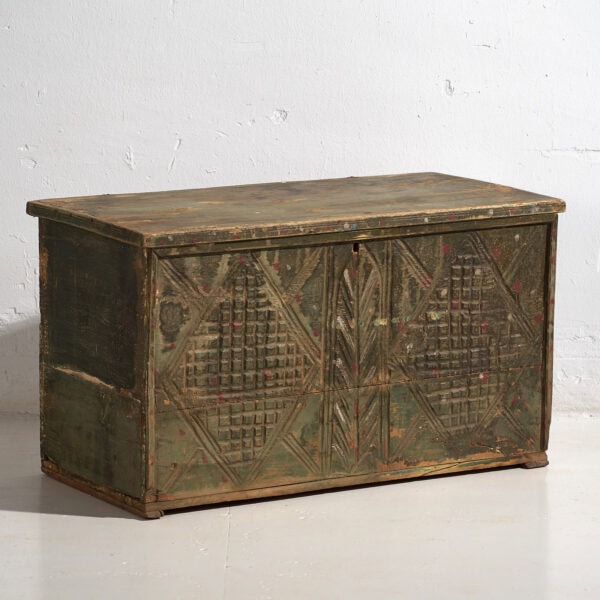


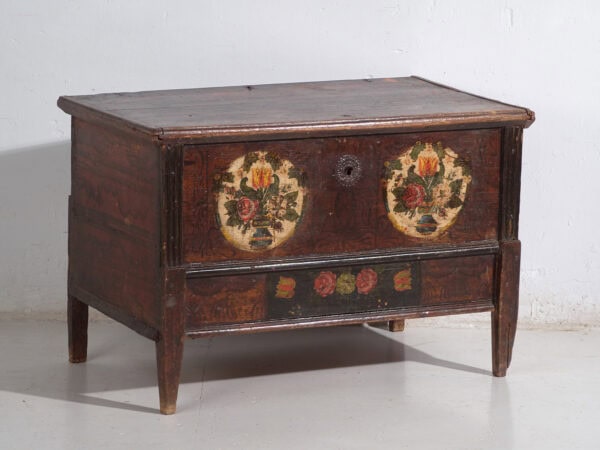


Antique Central European dowry chest in pine, hand-painted with floral cartouches across the front and dated to circa 1890. A domestic bridal piece halfway between a marriage ark and a linen coffer, characteristic of Tyrolean and Bohemian folk art from the last quarter of the 19th century.
Across the Alpine regions, the painted chest formed part of the dowry a bride brought to her marriage. It held textiles, embroidered garments and small personal belongings prepared over several years. The polychromy was never incidental: the central oval cartouches with tulips, roses and bouquets allude to fertility and renewal, motifs repeated by Central European folk painting throughout the 19th century.
It is built from pine boards joined at the corners and reinforced with internal cross-rails. The flat lid opens on wrought-iron hinges and retains its central lock plate. The front is organised by two oval cartouches over a white ground with painted bouquets, a central rosetted iron plate and a lower panel with a floral garland on a dark green field. The legs, turned and tapered outward, rest directly on the floor.
The patina is what gives the piece its identity: the reddish-brown polychromy of the body has darkened with time and lets the pine grain show through, while the floral cartouches retain all their chromatic freshness. The edges show natural wear and minor losses, and the lid bears use marks from generations of family handling. The surface is alive, unrestored, and keeps its documentary value.
Thanks to its compact scale and decorative weight, it sits naturally in contemporary rustic, eclectic, Mediterranean or country-house interiors, where it works as a chest at the foot of the bed, a low entrance bench with storage, a coffee table with character, or an anchoring piece in a bedroom. Its earthy tones converse easily with whitewashed walls, raw linen and pale woods.
Details
- Dimensions: Width: 95 cm Depth: 55 cm Height: 63 cm
- Style: Central European folk art, Tyrolean tradition
- Materials and techniques: Pine; mitred construction; original tempera polychromy; original wrought-iron hardware
- Place of origin: Central Europe (Tyrolean tradition)
- Period: Late 19th century
- Date of manufacture: Circa 1890
- Condition / Notes: Good. Original patina and paintwork. Wear consistent with age and use.
This piece is part of the collection of Amaru Antiques, Barcelona.
ONE OF A KIND PIECE