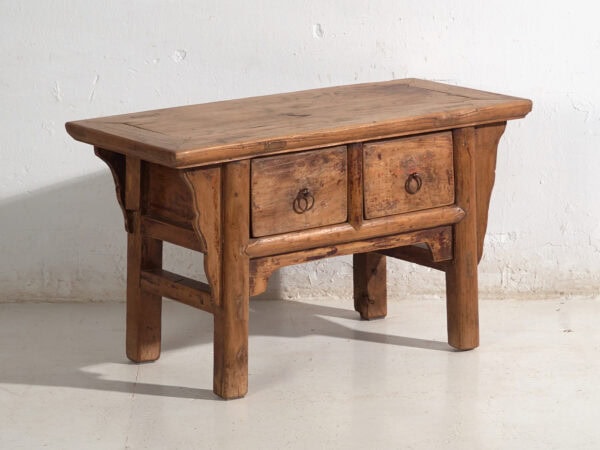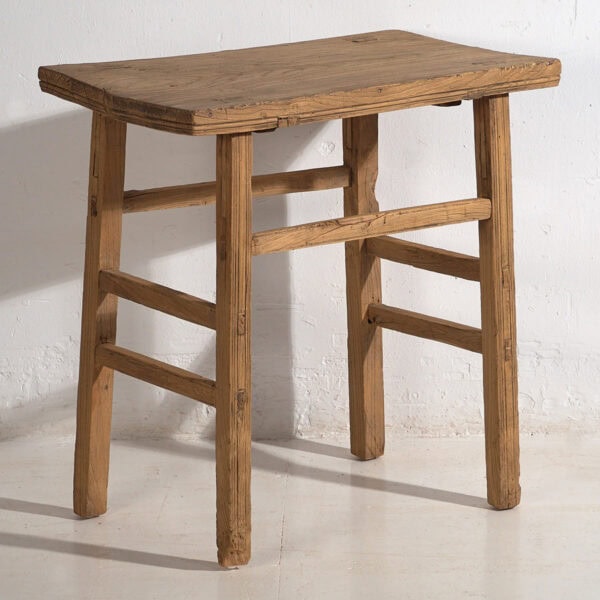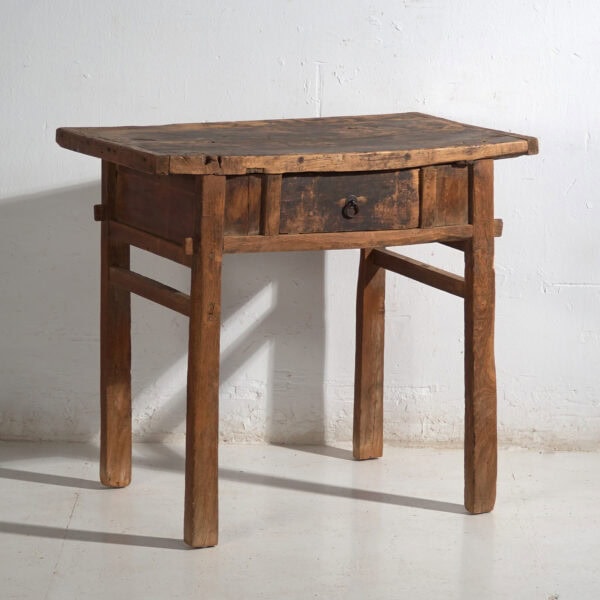


This antique Chinese console table in wood with assembled-plank top, perimeter moulding and curved-profile legs, is a domestic side piece from northern China around 1900. Originates from northern China, from the late Qing period, where local wood was worked using traditional mortise-and-tenon joinery.
Plain consoles with plank tops and curved legs were versatile pieces in the domestic spaces of northern China during the Qing Dynasty. Their direct construction and balanced proportions made them suitable for both residential interiors and commercial establishments.
The top is formed by assembled planks with mortise-and-tenon joints, framed by a square-section perimeter moulding. The four legs have a slightly curved profile at the lower end. The structure is solid and unornamented.
The wood shows a warm natural honey patina, with the grain visible on the tabletop surface. The wear is consistent with prolonged domestic use.
This console suits japandi, wabi-sabi or minimalist interiors. It works as a hall table, corridor console or living-room side piece.
Details
- Dimensions: Length 97 cm – Width 48 cm – Height 86 cm
- Style: Qing Dynasty
- Materials and techniques: Solid pine wood probably; traditional Chinese mortise-and-tenon joinery.
- Place of origin: China
- Period: Late Qing
- Date of manufacture: Circa 1900
- Condition: Good. May show marks and signs of use. Wear consistent with age and use.
This piece is part of the curated collection of Amaru Antiques, Barcelona.
ONE OF A KIND PIECE