

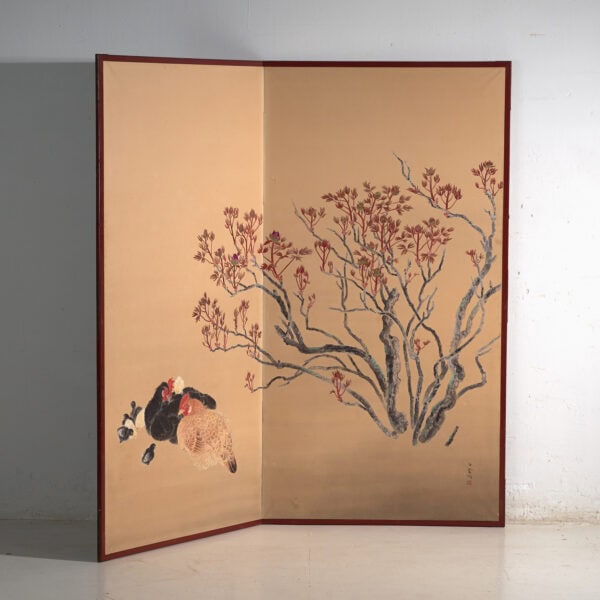


This antique Japanese two-panel screen is a byōbu in paint on a gold ground with a lacquered frame. It originates from Japan, from the Taishō period, when the two-panel screen served as a backdrop and a divider in the home.
The two-panel byōbu was placed behind a seat, beside an entrance or as the backdrop of a composition, and folded away for storage. The gold ground placed it as a piece of some prestige.
The two panels are paper mounted over a wooden lattice, joined by paper hinges, with a red lacquered frame and a patterned-paper back. The painting occupies the continuous surface of the two panels.
The composition depicts a flowering tree and a pair of fowl on a gold ground, in colour on paper, with the artist’s signature and seal. The gold ground heightens the motif and brings light to the scene.
For its two-panel format, it serves as a decorative backdrop, an occasional divider or a wall piece. It fits wabi-sabi, japandi and eclectic interiors, where it brings warmth and a golden accent.
Details
- Dimensions: Length 180 cm – Width 2 cm – Height 172 cm
- Style: Traditional Japanese
- Materials and techniques: Painted paper on a gold ground over wooden lattice; paper hinges; red lacquered frame.
- Place of origin: Japan
- Period: Taishō period
- Date of manufacture: Circa 1920
- Condition: Good. Patina and marks consistent with age on paper and frame. Folded dimensions: Length 90 cm – Width 4 cm – Height 172 cm. Wear consistent with age and use.
This piece is part of the curated collection of Amaru Antiques, Barcelona.
ONE OF A KIND PIECE