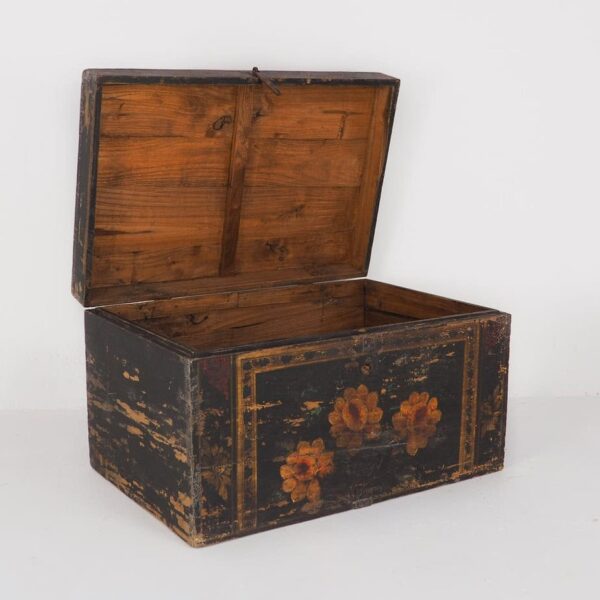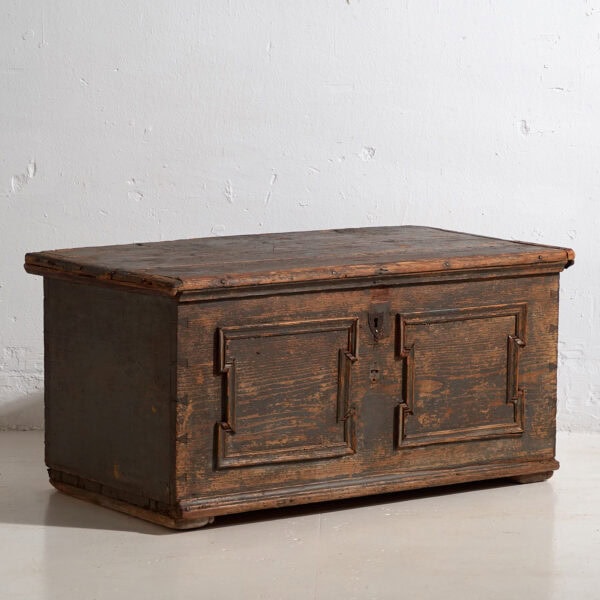


This antique painted trunk in pine wood features a front over an ochre yellow ground with two symmetrical panels showing compositions of peonies, lotus, carp and butterflies framed by a huiwen border at the corners. It originates from northern China, from the late nineteenth or early twentieth century, where pine was worked using dovetail joinery and decorated with hand-applied paint over a coloured ground.
In traditional Chinese furniture, medium-sized painted trunks belonged to the domestic trousseau and, in many cases, to the bridal dowry. They were used to store textiles, festival clothes and ritual goods. Ochre yellow was a frequent choice in the popular furniture of northern and central China — a colour associated with autumn, agricultural abundance and domestic prosperity.
The body is built in solid pine, joined by visible dovetail corners. The top is a loose lid that lifts off to give access to the interior — a common solution in Chinese utilitarian trunks for domestic storage. The sides and the back are kept in natural unpainted pine, characteristic of the popular register. The structure is fully solid and the hardware is functional.
The decoration covers the front with a symmetrical composition organised in two rectangular panels framed by a double line in turquoise green and red. An outer band with huiwen (回紋) zigzag motifs runs across the four corners. Each panel shows a floral composition with peony (mudan 牡丹) in pink, yellow and orange, lotus (lian 蓮) emerging from the water and a carp (yu 鱼) swimming beneath the flowers over white wavy lines suggesting a pond. Butterflies (die 蝶) flit among the stems. The combination of lotus and carp is the classical good-auspice formula lian nian you yu (連年有餘) — “abundance year after year” — a common wish for household and trade in Chinese material culture. The peony adds wealth and honour; the butterfly, longevity through homophony with 耋 (octogenarian) and, alongside flowers, marital joy. The palette combines ochre yellow ground, orange, pink, green, turquoise and black strokes.
The paintwork presents the fine wear characteristic of natural aging over more than a century. On the top lid, the yellow layer has worn away in large areas and reveals the bare pine in warm tones — an honest reading of continuous domestic use across generations. On the front, the painted motifs keep their saturation and remain fully legible. The patina is honest, with no invasive restoration.
With its contained proportions — 67 × 56 × 57 cm — this trunk works as a side table, low coffee table, bench at the foot of a bed or central decorative piece in an entrance. The deep ochre yellow brings warmth and a warm chromatic accent into light or sober interiors. It fits wabi-sabi, contemporary rustic, japandi and Asian-inspired projects.
Details
- Dimensions: Length 67 cm – Width 56 cm – Height 57 cm
- Style: Late Qing Dynasty / Early Republic
- Materials and techniques: Solid pine; original side handles; dovetail joinery; loose top lid; original paintwork over ochre yellow ground with floral polychromy, carp and huiwen border.
- Place of origin: Northern China
- Period: Late 19th century – early 20th century
- Date of manufacture: Circa 1900
- Condition: Very good. Original patina and paintwork very well aged, with no invasive restoration. Fully solid structure and functional hardware. Wear consistent with age and use.
This piece is part of the curated collection of Amaru Antiques, Barcelona.
ONE OF A KIND PIECE