

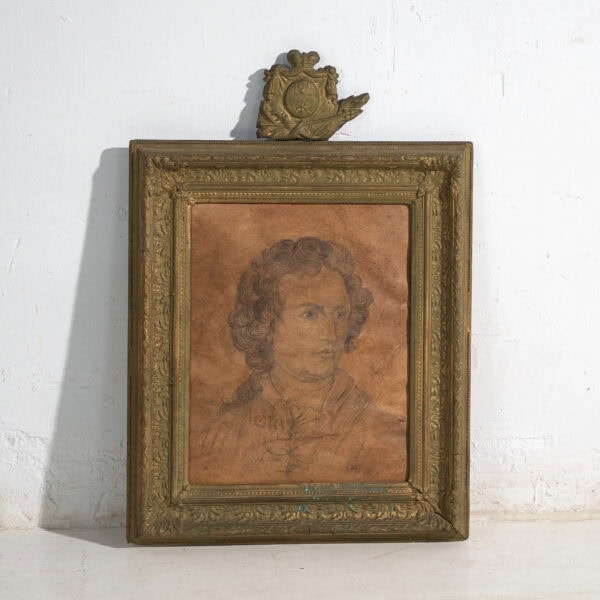


Antique pencil portrait in gilded frame, on parchment-toned paper, set in a gilt stucco moulding with a heraldic crest of crown and shield. It originates from Central Europe, from the first half of the nineteenth century, when graphite and charcoal portraiture was cultivated as an intimate genre within bourgeois and aristocratic portraiture.
The Romantic-period drawn portrait stood between the personal document and the cabinet piece. Compared with oil — more ceremonial — drawing allowed greater intimacy: short sittings, attention to character. It was framed with the same care as a larger painting. The heraldic crest crowning the moulding confirms the sitter’s rank and ties the portrait to a particular lineage.
The drawing is executed in graphite and charcoal over paper toned in an ochre wash, a technique common among German and Austrian portraitists of the late Biedermeier. The young man is shown three-quarter-view, with curled hair and a high cravat, in the contained pose of academic portraiture. The moulding is water-gilt stucco over a wooden core, with leaf-and-rosette ornament at the corners, preserving the original openwork crest above.
The overall patina is warm and honest, with the paper slightly cockled and darkened by time, the drawing well preserved and the gilding worn at edges and corners, exposing the reddish bole beneath. The heraldic crest also shows localised losses consistent with its age.
It sits naturally in eclectic, classical or curated contemporary interiors. It works as a solitary piece on a sideboard, in a gallery wall alongside other antique portraits, or as a historical accent in a quietly furnished bedroom, where the sitter’s gaze acts as a silent focal point.
Details
- Dimensions: Length 59 cm – Width 5 cm – Height 85 cm
- Style: Romantic (late Biedermeier)
- Materials and techniques: Parchment-toned paper and wood with gilt stucco; graphite-and-charcoal drawing; water gilding over bole; openwork heraldic crest.
- Place of origin: Central Europe
- Period: First half of the nineteenth century
- Date of manufacture: Circa 1840
- Condition: Good. Localised losses on gilding and crest. Wear consistent with age and use.
This piece is part of the curated collection of Amaru Antiques, Barcelona.
ONE OF A KIND PIECE