


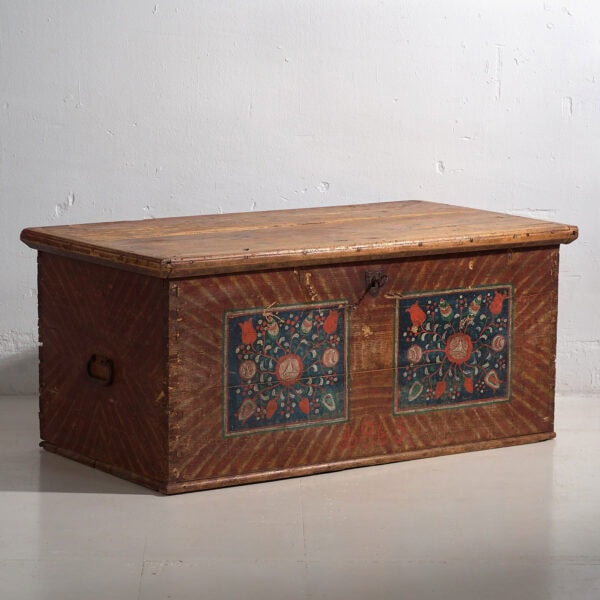


This painted dowry chest is a Central European marriage trunk dated 1865, built from solid pinewood and decorated with two polychrome panels set against a ground of diagonal red and ochre rays.
Pieces of this kind circulated across the rural regions of the Austro-Hungarian Empire during the second half of the nineteenth century, where the painted chest formed part of the bride’s trousseau: it held the dowry — woven linens, household textiles, personal belongings — and travelled with her to the marital home. The decoration, with red tulips, pomegranates and stylised floral motifs on a deep blue ground, belongs to the vocabulary of Central European folk art, in which each flower stands for fertility and the prosperity of the marriage. The figure “1865”, painted in red across the foot of the front, fixes the year of the wedding.
The construction is honest and robust: pine boards joined with exposed dovetails at all four corners, a perimeter base with a simple moulding, and a flat hinged lid on forged-iron pivots. An original wrought-iron handle, mounted over the painted rays, survives on the side. Inside, a lateral till — a small running compartment beneath the lid — was used to keep jewellery, documents or small family treasures.
The paintwork is original and untouched. The diagonal rays in red-ochre and yellow ochre draw a centrifugal scheme that frames the two blue panels on the front; within each panel, symmetrical bouquets of red tulips, pomegranates and vegetal elements unfold the characteristic floral cluster. Time has lent a warm patina, with coherent wear at edges, lid borders and points of use, and the iron hardware shows a quiet oxidation that confirms its age.
In a contemporary interior, the chest works as a low coffee table in front of the sofa, at the foot of a bed, or as an entry piece; it brings colour, narrative and character without needing anything added. It sits comfortably alongside rustic, Mediterranean, Scandinavian or eclectic interiors, where its polychromy introduces a vivid note.
- Type: Painted dowry chest
- Style: Central European folk art
- Materials and techniques: Pinewood, distemper polychromy, forged-iron hardware
- Place of origin: Central Europe — Austro-Hungarian Empire
- Period: Second half of the 19th century
- Date of manufacture: 1865
- Dimensions: Length 121 cm – Width 64 cm – Height 54 cm
- Condition: Original paintwork preserved; honest patina consistent with age; original hardware
At Amaru Antiques in Barcelona, we select each piece for its authenticity, its materiality and its ability to converse with contemporary interiors.
UNIQUE PIECE


