

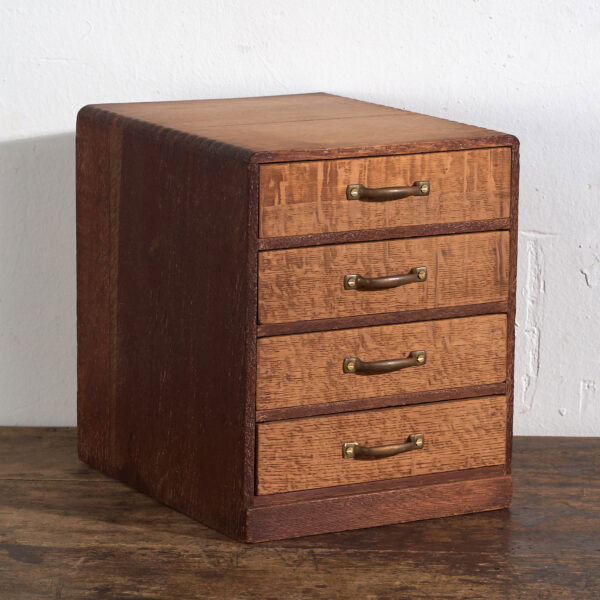


Small Japanese kotansu chest of drawers with four drawers, fronts in zelkova (keyaki) and sides in sugi, made in Japan in the mid-Shōwa period. A compact tabletop piece halfway between an auxiliary chest and a Japanese ordering cabinet, characteristic of 20th-century Japanese household furniture.
During the Shōwa period, small kotansu — direct heirs of the tansu tradition — became popular as auxiliary pieces for the desk or the room. They were used to keep small treasures, sewing thread, stationery, jewellery or notes in a separate drawer for each thing. Their reduced size made them frequent on top of a desk, a larger chest of drawers or a chigaidana shelf.
It is built with drawer fronts in zelkova (keyaki) — prized for its spectacular grain — sides and back in sugi (Japanese cedar) and reinforcements in local wood. The four drawers are assembled with traditional joints and finished with brass pulls in the form of a horizontal handle on a recessed rectangular plate, characteristic of the Japanese workshop. The edges are finished with a thin moulding that protects the softer wood.
The patina is warm and very even: the keyaki front shows all the character of the grain — wavy, with almost watery figurations — under a matte varnish that use has settled. The sides, in darker sugi, contrast with the fronts and give the piece a double chromatic reading that feels deeply Japanese. The hardware retains its original golden tone.
Thanks to its compact scale and refined finish, it sits naturally in japandi, wabi-sabi, minimalist or contemporary interiors, where it works as a desk organiser, a bedroom jewellery chest, an auxiliary bathroom piece or a decorative element on top of a larger chest of drawers. Its cubic proportions introduce a Japanese accent without saturating the space.
Details
- Dimensions: Width: 26 cm Depth: 33 cm Height: 32 cm
- Style: Japanese tansu, Shōwa period
- Materials and techniques: Fronts in zelkova (keyaki); sides in sugi (Japanese cedar); original brass pulls on recessed plate
- Place of origin: Japan
- Period: Shōwa period
- Date of manufacture: Circa 1950–1970
- Condition / Notes: Good. Even natural patina. Wear consistent with age and use
This piece is part of the collection of Amaru Antiques, Barcelona.
ONE OF A KIND PIECE