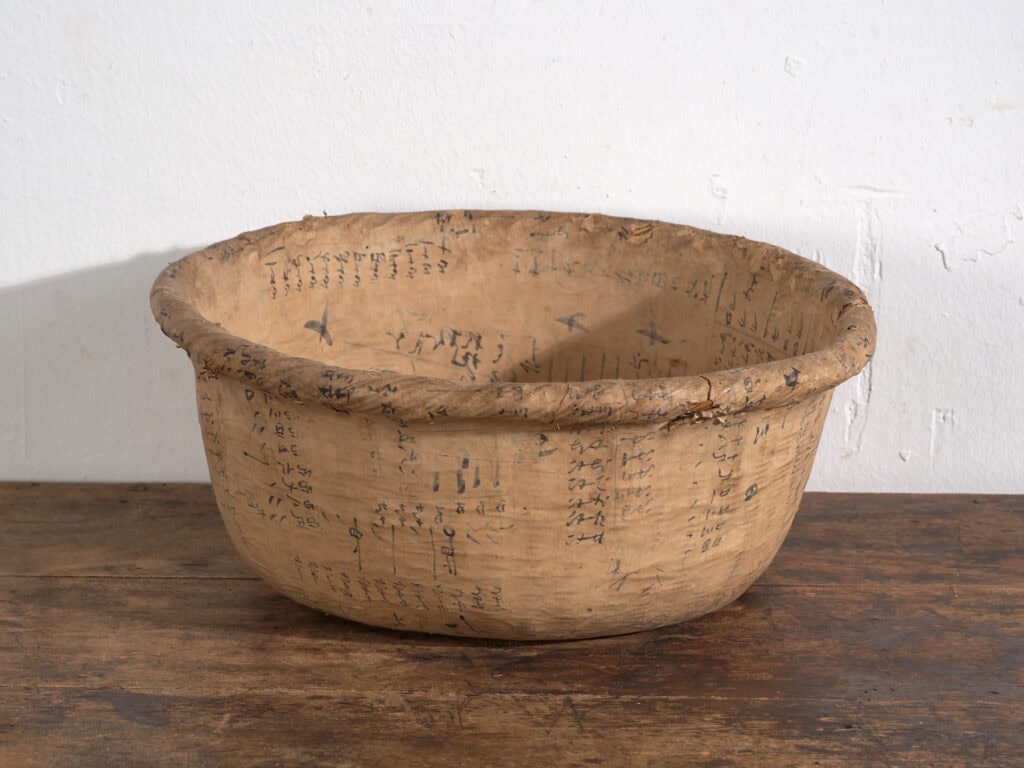


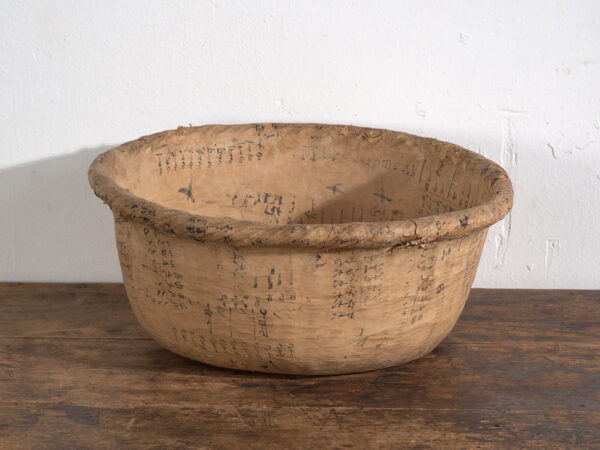
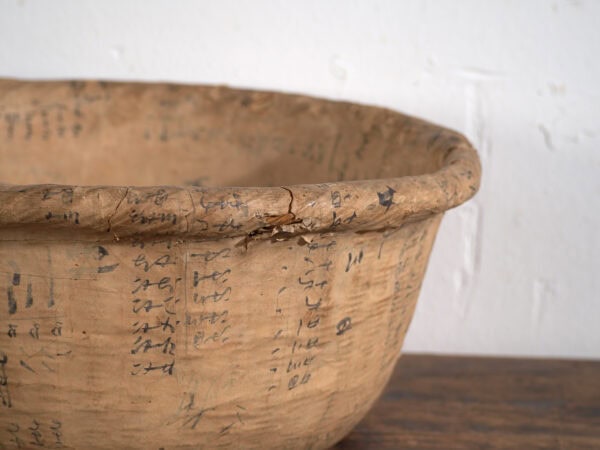

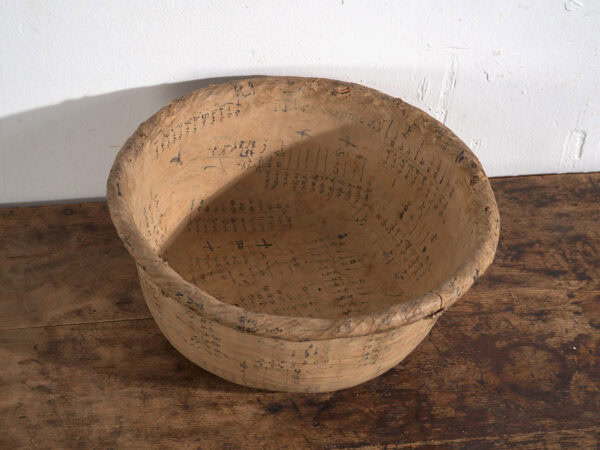

Antique Japanese tally bowl in washi paper, of round form and hand-rolled rim, decorated across its entire surface with handwritten characters and tally marks in black ink. It originates from Japan, from the Taisho or early Showa period, when Japanese workrooms and shops used lightweight bowls of laminated washi paper to keep daily records of production.
The tally bowl — a variant of harikō (Japanese papier-mâché) applied to the workroom — served at once as container and as improvised notebook. Each ink inscription records a date, a name, a quantity or a group of marks (正 shō) the accountant traced to total deliveries. Prolonged use gradually covered the whole piece in notes, turning it into a material archive.
It is built of washi paper laminated by hand over a thin wooden core, stiffened with starch paste and coated with a layer of gofun (calcium carbonate) that gives the creamy ground tone. The rim is rolled and reinforced with several extra layers of paper, giving the piece its characteristic thick, organic silhouette. The whole is very light despite its size.
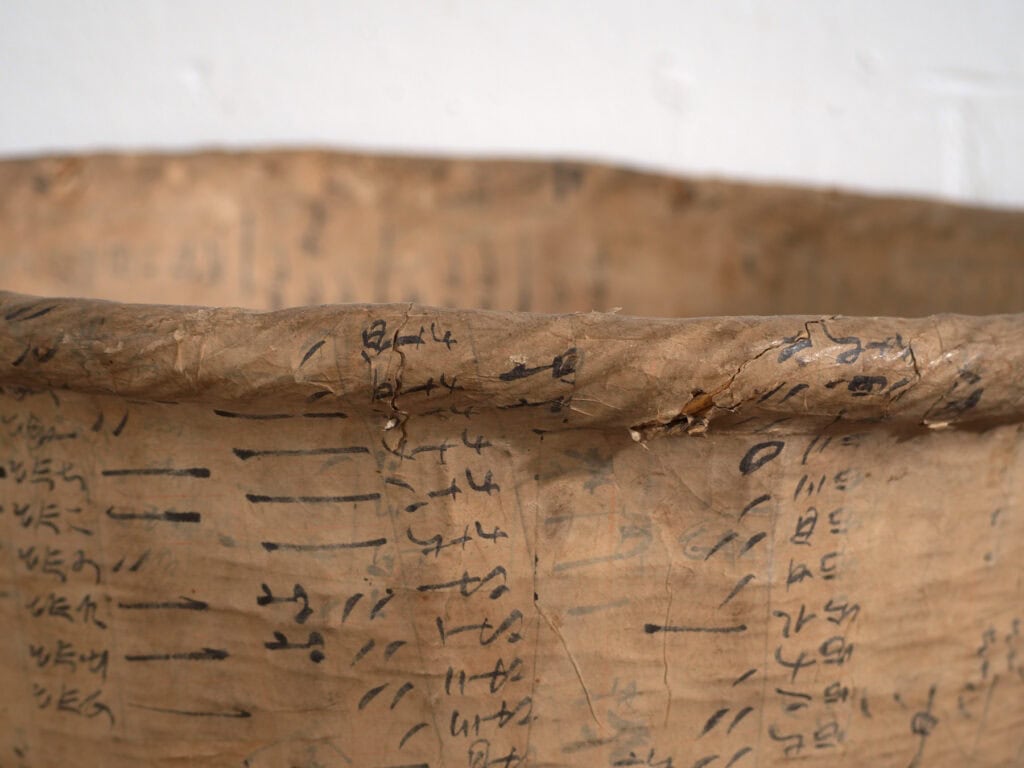
The calligraphy is the merchant’s hand, fast and functional, brush-painted in fine black ink. It runs across the whole body and the inside, organised in short lines with tally marks between the figures. The palette combines the cream of the gofun with the black of the ink, in a composition that is at once austere and narrative.
The patina is that of prolonged use, with the paper softly worn at the most-handled points, some surface losses on the rim and the ink softened in the rubbed areas. Every mark preserves the material trace of its accounting function — this is not a retroactively decorative object, but a three-dimensional notebook that has reached us intact.
It sits naturally in wabi-sabi, japandi or contemporary eclectic interiors. It works as a decorative vessel on a console, as a bowl for fruit or pinecones in an entrance, or as a standalone object in a vitrine, where the handwritten calligraphy acts as the only graphic note.
Details
- Dimensions: Length 41 cm – Width 39 cm – Height 19 cm
- Style: Traditional Japanese, Taisho / early Showa
- Materials and techniques: Hand-laminated washi paper over a wooden core; gofun (calcium carbonate) coating; brush-painted calligraphy in black ink.
- Place of origin: Japan
- Period: Taisho / early Showa
- Date of manufacture: Circa 1920
- Condition: Good. Some marks consistent with use. Wear consistent with age and use.
This piece is part of the curated collection of Amaru Antiques, Barcelona.
ONE OF A KIND PIECE