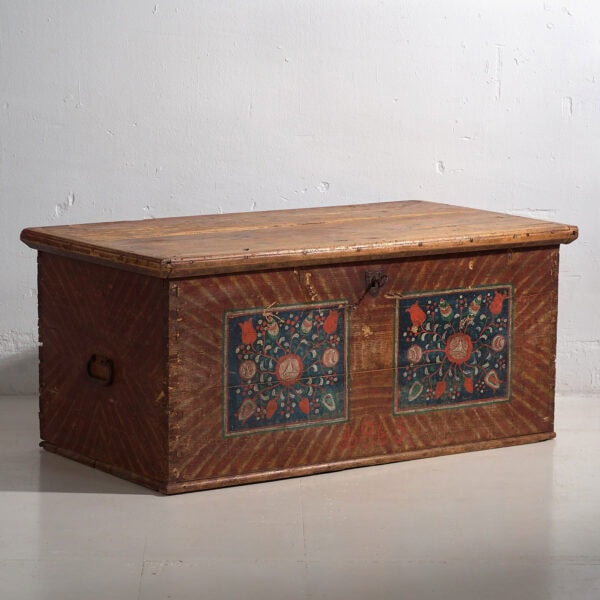


Antique painted Chinese trunk in pine wood, provincial painted furniture with figurative scene originating from Inner Mongolia and dated circa 1900. Originates from Inner Mongolia, in northern China, from the late 19th century, where local pine was worked using mortise-and-tenon joinery without nails, with fronts painted in polychrome figurative and floral compositions.
In the Mongol homes of northern China, painted trunks were central pieces of the wedding trousseau and the family treasury: they held textiles, clothing and personal objects, and fulfilled both a symbolic and a decorative function. The density of the pictorial decoration on the front matched the social role of the piece within the home, equivalent to that of large lacquered furniture in other regional traditions.
Built in solid pine using traditional mortise-and-tenon joinery, without nails. Rectangular case with a hinged lid and forged iron front fittings allowing closure with a padlock. The front concentrates all the pictorial decoration, arranged in a central rectangular panel flanked by two vertical lateral panels and upper and lower borders with a floral composition.
The central panel represents an interior scene with three female figures wearing traditional garments — red, green and pink — gathered beside a table and a draped red curtain. The calligraphic inscription on the right lateral panel reads 小英雄 (xiǎo yīngxióng, “little hero”), the narrative title of the scene. Beside it appears a white rabbit, symbol of longevity and purity in the Chinese repertoire. The borders and lateral panels articulate floral compositions with peonies (mudan 牡丹, emblem of wealth and honour), chrysanthemums (longevity) and pomegranates (fertility), over a deep blue ground. The palette — blue, red, yellow, green — is characteristic of popular painting from northern China and Inner Mongolia in the late Qing period.
The patina retains the original pigments with a matte sheen and an irregular surface. The painting on the front shows soft losses and craquelure proper to natural ageing; the sides and lid show broad abrasions in contact areas and the wood shows through at various points. The structure remains solid, the original fittings in place.
It fits naturally in eclectic, wabi-sabi or contemporary rustic interiors. It works as a low coffee table, a storage piece at the foot of a bed or an autonomous decorative piece in an entrance. The density and narrative of the pictorial composition turn it into a visual focus within a sober space.
Details
- Dimensions: Length 86 cm – Width 55 cm – Height 61 cm
- Style: Painted provincial furniture from Inner Mongolia
- Materials and techniques: Solid pine, pigments on wood, forged iron hardware; mortise-and-tenon joinery without nails, painted front with central figurative scene, calligraphic inscription, polychrome floral borders
- Place of origin: Inner Mongolia, China
- Period: Late Qing dynasty (circa 1900)
- Date of manufacture: Circa 1900
- Condition / Notes: Sound structure. Original paint with soft losses and craquelure. Original fittings. Wear consistent with age and use.
This piece is part of the collection of Amaru Antiques, Barcelona.
ONE OF A KIND PIECE